
Safer swimming tips for 2026
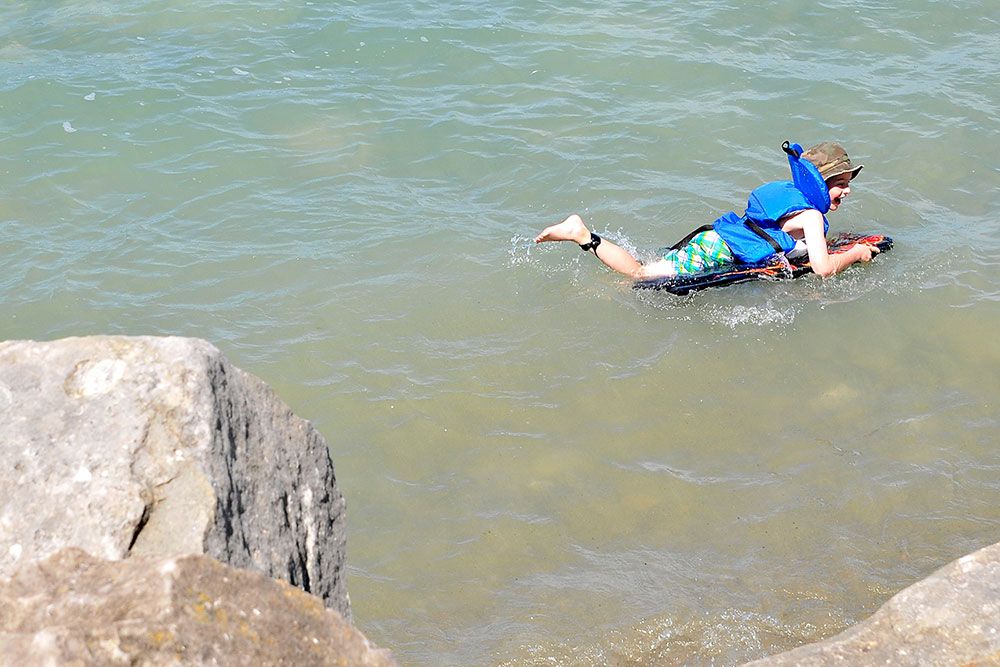
Visit local public health websites and social media for safe swimming best practices and water quality information
As spring turns into summer, many individuals and families, either visiting Lake Huron or living in the area, think of swimming in the lake.
As you make decisions about if, where and when to swim, don’t forget to visit local public heath websites and social media channels to learn about safe swimming practices and, where available, water quality information for Lake Huron public beaches.
The area of the Healthy Lake Huron partnership stretches from Sarnia to Tobermory. Recreational water use is popular along Lake Huron’s southeast shore. Swimming can benefit your health and well-being if done safely. Still, the possibility of injury or illness from recreational use in the lake is a reality. This water may be polluted or unsafe. Organisms such as bacteria, viruses, and parasites can cause infection and human illness. These organisms can be present in natural bodies of water.
In some areas, along Lake Huron’s southeast shore, beaches may be closed or posted throughout the summer months. Whatever the signs say, or don’t say, it is important to know about the times the lake is likely to become most contaminated and about best practices to help reduce risk to you and your family.
The quality of Lake Huron water can change dramatically day to day, hour to hour, or even minute to minute.
The dramatic change in water quality may result from heavy rainfall, high wave action, or both.
The water may have high levels of bacteria that could increase the risk of skin, eye, ear, nose and throat infections or gastrointestinal illness.
In some cases, in some areas, local beaches may be closed or posted if local public health believes there may be a risk to the public when the levels of Escherichia coli (E. coli) exceed (or are predicted to exceed) the federal guidelines and provincial standard (200 E. coli per 100 mL of beach water) for recreation. Other factors, such as environmental conditions, may also cause beaches to be posted and/or closed.
When visiting an area near the lakeshore, be sure to visit local public health websites and social media for updates and to learn about the presence or absence of beach water quality sampling programs in that area.
In some cases, predictive beach models are used and reviewed to reduce the time required to use beach water sampling; to provide real-time or same-day water quality information; and to reduce the impact of extended beach postings.
Some local public health agencies conduct monitoring and testing on a number of public beaches but swimming and recreational conditions can change quickly. It’s important to be aware of recent weather events, and the impact weather can have on recreational water quality. It is not possible for public health to monitor all beaches at all times or monitor for all potential pollutants.
When beaches are monitored they conduct testing for E. coli levels only. Local public health generally does not test other bodies of water such as creeks and streams, rivers, ravines, gullies, or dams. Residents should be aware these areas are likely to be unsafe for swimming.
E. coli levels can be influenced by rainfall, turbidity (water clarity), air and water temperature, as well as the features of the coastline.
Additional sources of E. coli may include, among other things, animals and waterfowl, malfunctioning sewage disposal systems, and stormwater runoff carrying chemicals and excess nutrients into creeks, rivers, and the lake.
Positive actions are required to manage water running off the land if we want a Lake Huron that is fishable, drinkable (after the raw water source is treated), and swimmable. To help protect Lake Huron water quality, you can save, seed and steward:
- Save by preserving natural areas.
- Seed by creating natural areas.
- Steward existing areas.
Find out about positive actions you can take to reduce impacts on creeks, rivers, groundwater, and Lake Huron. Visit the websites of local conservation organizations for positive actions you can take to better manage water running off of land and to reduce the potential for contamination of streams, rivers and Lake Huron.
Read and heed any beach water quality signs but don’t rely on signs and postings alone.
Beachgoers should make informed decisions about beach water quality in real time before they decide to go swimming or not. When you have all the facts, you may be the best judge of whether the water is safe to swim.
There is always risk when swimming in a watercourse but you can make informed decisions to manage and reduce that risk.
Rules of Thumb for Safer Swimming
Here are some ‘rules of thumb’ to guide you:
- If the beach is posted with a warning sign, don’t swim.
- If there has been a heavy rainfall in the previous 24 to 48 hours, don’t swim. (Bacteria levels may be higher).
- If you can’t see your feet at adult-waist depth, cloudy water can mean that bacterial levels may be higher and, in that case, don’t swim.
- If there is a large number of water fowl, dead fish, algae, scum, or dangerous debris … don’t swim.
- Also – do not ever swallow lake water … no matter how clean it looks.
Even if warm weather hasn’t arrived yet, it’s never too early to follow your local public health channels (websites and social media) for information on beaches and water quality – and other local public health issues.
Here are some ways to find out more:
Online Sources along Lake Huron’s Southeast Shore:
Local public health is an important partner in the Healthy Lake Huron (HLH) – Clean Water, Clean Beaches Partnership.
Here are some of the local public health web pages with information on water quality at local beaches and/or safe swimming practices:
Social Media Channels along Lake Huron’s Southeast Shore:
On Twitter/X:
To follow Huron Perth; or Grey Bruce local public health Twitter/X feeds you may visit here:
- GreyBrucePublicHealth @GBPublicHealth
- Huron Beach Info @HuronBeachInfo
On Facebook/Meta:
You may also ‘like’ and ‘follow’ the Huron Perth Public Health; Lambton Public Health; or Grey Bruce Public Health Facebook pages here:
On Instagram
To follow local public health, along Lake Huron’s southeast shore, on Instagram visit: